| GOLF INSTRUCTION From Fall 2007 Florida Golf Magazine ©Copyright 2007, All Rights Reserved. | |
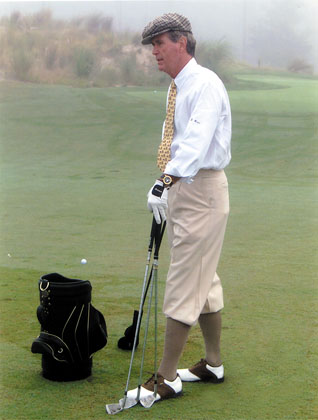 Dr. Gary Wiren, Ph.D. Finding Your Best Swing Man
has been fascinated by the challenge of the unknown, the resolution
of apparently insoluble problems, some worthy, others capricious.
One persistent enigma that has tantalized the minds and tested
the skills of sportsmen since the 17th century has been "the
search for the perfect golf swing." Legions have committed
their time and talents toward this end, but none have dedicated
his enthusiasm and resources in such grand manner as did Britisher
Sir Ainsley Bridgland. Sir Ainsly made what might inelegantly
be described as a "potful" of money in real estate
in and around London. But his penchant for business didn't dilute
his ardor for golf. If anything his financial success seemed
to sharpen his hunger for greater competency in the game. |
Working
through the Golf Society of Great Britain, Bridgland helped form
a first-rate research team of specialists representing a variety
of disciplines: biomechanics, engineering, anatomy, physiology,
ballistics, medicine, physical education and ergonomics. The
team experimented, discussed and analyzed various elements of
the game of golf for more than five years. These sessions culminated
in golf’s most fascinating technical book, The Search For
The Perfect Swing (Lippincott 1968) by physicist-author Alistair
Cochran and golf writer John Stobbs. If Brigland was looking for “the secret” he probably was disappointed (although we certainly may profit from his investment.) For what developed from reams of experimental test data, mathematical models, hypothesis and computer printouts probably was not the answer Bridgland sought. The conclusion: Although a model can be constructed which exemplifies sound principles, there is no perfect swing. Rather, there are a variety of possibilities that are functional and can be considered correct as long as they do not violate physical law. From this conclusion there follows a rationale. If there is no perfect swing to make, then there can be no perfect swing to teach. That is, no one swing for all players. If the individual differences in pupils allow for variety in the swing, they also must allow for variety in teaching. Or to put it another way: the Search for the Perfect Teaching Method is a modern myth! Don’t be misled into thinking that a single method approach to teaching is ineffective. On the contrary, it is something very effective since it leaves no room for doubt, and doubt is devastating to the golf swing. But the success of a rigid approach has a very strong condition attached. It works, providing . . . providing the student happens to fit the system. Some methods find great success with muscularly weak, inflexible or elderly people but fall short of fully helping the young. There are many people teaching golf in many ways. In itself, this is not wrong. Confusing, yes, but not necessarily wrong. And it has been like this for most of the game’s history. We have had proponents of one style or another, either as teachers or players, who have drawn battle lines against all approaches that differ from their own. Having a teaching procedure or method is a sign of an organized instructor. The good teacher has a method; the great teacher has many. The good teacher prescribes; the great teacher diagnoses, evaluates and prescribes. Recognizing individual differences in students makes teaching an art. Golf is learned far easier and faster when you are being assisted by a knowledgeable teacher. Now, go find yourself a teaching artist who can help you find you best swing. |
| From Fall 2007 Florida Golf Magazine ©Copyright 2007, All Rights Reserved. Subscribe at www.floridagolfmagazine.com/subscribe | |